Project Overview
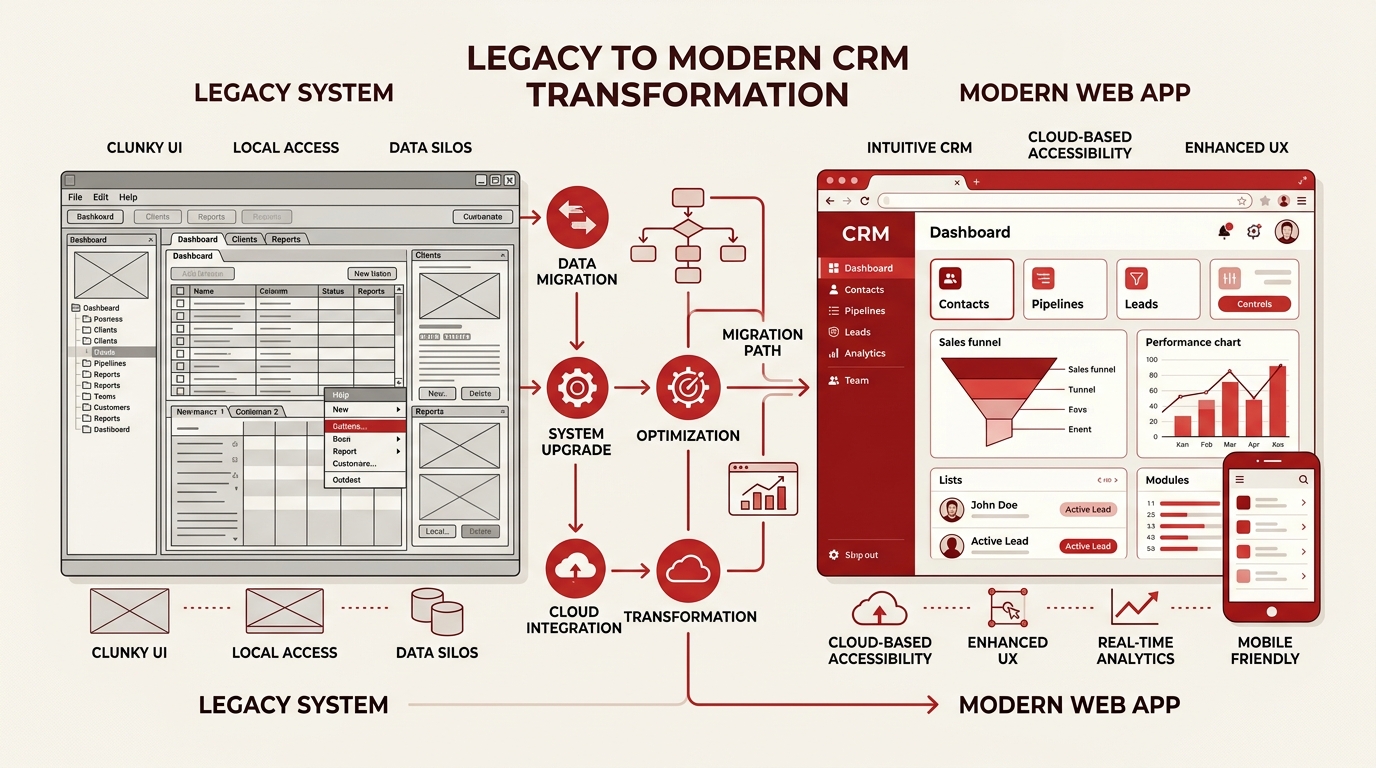
The financial firm was constrained by an aging C++ desktop CRM. The codebase was difficult to maintain, incompatible with modern web APIs, and restricted to Windows environments. As the firm grew, the legacy system could no longer handle the required volume of real-time financial analytics.
Our team executed a complete rewrite, replacing the C++ application with a modern Next.js architecture. The new CRM was deployed as a web application for broad accessibility and as an Electron desktop app for power users requiring multi-monitor support and native file system access. PostgreSQL was utilized to handle the complex, high-volume financial data. The new system unified their wealth management workflows and paved the way for advanced machine learning analytics.
Have a similar challenge?
Our experts can help you evaluate your current systems and map out a modernization strategy.
Key Challenges
High Technical Debt
An aging, unmaintainable C++ codebase riddled with decades of technical debt made implementing new features nearly impossible.
API Incompatibility
The legacy architecture was fundamentally incompatible with modern third-party financial APIs and web-based services.
Platform Lock-in
The application lacked cross-platform support, restricting financial advisors to Windows-only desktop machines.
Abysmal Performance
The system suffered from extremely poor performance when attempting to run complex financial analytics on large, modern datasets.
Results & Outcomes
The new CRM empowered financial advisors with modern tools, cross-platform access, and seamless integrations with external financial services. The transition to PostgreSQL and optimized API endpoints reduced complex report generation times from minutes to seconds. The firm now has a scalable, future-proof platform free from legacy technical debt.
Ready to build your custom software?
From purpose-built enterprise tools to legacy modernizations, we have the experience to deliver.
Explore Software Faktory ↗Frequently Asked Questions
Common questions about this project and our approach.
How did you ensure accuracy when rewriting complex C++ financial algorithms?
We employed a rigorous parallel testing strategy. The new Next.js/Node.js algorithms were run side-by-side with the legacy C++ algorithms using historical data, ensuring byte-for-byte accuracy before final deployment.
Why was PostgreSQL chosen over the legacy database system?
PostgreSQL offered superior performance for complex queries and robust relational data integrity, which is critical for financial reporting, while integrating perfectly with modern Node.js ORMs.
Can the new CRM be easily scaled for a growing remote workforce?
Yes, transitioning from a heavy desktop client to a web-based architecture (accessible via browser or Electron) ensures it can be instantly deployed to new employees anywhere in the world.
What impact did the Next.js migration have on the CRM deployment process?
It completely transformed it. Instead of manual desktop installations, updates are now pushed instantly to the web version, and Electron auto-updater seamlessly updates the desktop clients without user intervention.
How does the new architecture handle complex data visualizations?
We integrated modern charting libraries into the Next.js frontend, allowing financial advisors to view dynamic, interactive visualizations of client portfolios that were impossible in the old C++ app.
Are legacy data formats still supported for importing historical records?
Yes, we built a dedicated data ingestion pipeline in Node.js that parses and sanitizes legacy file formats, ensuring historical data is perfectly preserved in the new PostgreSQL database.